When you put it into one paragraph it's truly shocking.
Most terrorists like to blow stuff up and get caught, or
martyred, and end of story.
The cunning ones try to destroy the polity from inside the
system.
That's what we got in the EU, right now.
Checkitout: taki's mag [follow the link for more. it's gooood]
Nothing Left to Steal
by Taki Theodoracopulos November 10, 2011
Another thing you Brits forgot: Delors, Trichet, and the generation of 1968 are now in the positions of power. The ludicrous Baroness Ashton—still cramming to understand what the word bonjour means—was a CND/CPGB fellow traveler; Javier Solana an ex-Trotskyite; Manuel Barroso an ex-Maoist; Joschka Fisher an ex-terrorist; and so on. In other words, the scum that failed to win power over us through force of arms is now leading us by the nose through stealth and the EU Trojan horse. Somebody wake up David Cameron.....
[Please share this article by using the link below. When you cut and paste an article, Taki's Magazine misses out on traffic, and our writers don't get paid for their work. Email editors@takimag.com to buy additional rights. http://takimag.com/article/nothing_left_to_steal/print#ixzz1dVAxJAlw
Monday, 14 November 2011
the opposite of the Big Bang is Big Implosion
the freeing of the stock markets under Maggie THatcher
was known as the Big Bang. Nice metaphor.
Except it should have killed most of the bankers with its
force in much the same way that it is hurting society now.
Indeed it's causing a Big Implosion in the rest of society.
checkitout: Guardian
Who can deliver the cultural Big Bang that the City needs?
Thatcher's unleashing of the markets led to crisis 25 years later. Now only politicians, if they have the guts, can force reform
David Kynaston guardian.co.uk, Monday 24 October 2011 22.00 BST
Big Bang created the City we know today, but this week's 25th anniversary is not an occasion for triumphalism. Severe faultlines in our financial system continue to bear heavy responsibility for the debilitating economic conditions that have persisted since the banking dramas of 2007-8. Reform is needed as urgently now as it was then, but over recent years dismayingly little has been achieved. Even so, City history tells us not only that change-minded politicians have on occasion been able to bend the City to their will, but that the City has always been capable, for all its protests, of adapting to new external pressures.
Big Bang itself took place on 27 October 1986 and was essentially the deregulation of the stock exchange, opening up its member firms to foreign ownership, mainly American banks. It conclusively signalled the third phase of the City of London's modern history and sought to reprise the marvels of the first phase which ended with the onset of the first world war. Before that, for almost a century, the City was in its freebooting pomp, dispensing capital and credit to all quarters of the globe and becoming the greatest international financial centre the world had seen.
The second phase, from the end of the 1914-18 war to the mid-80s, began with New York supplanting London, compelling the City to engage closely for the first time with British industry. But the rise of the European markets in the 60s, followed by the floating of exchange rates and abolition of exchange controls, meant that by the early 80s the forces for a re-internationalisation of the City had become irresistible. Yet they were still mostly resisted by the City itself, a complacent place where restrictive practices ruled and the living was largely easy. Thus the Margaret Thatcher-imposed Big Bang.
Phase three would prove, in its own terms, a brilliantly conceived and realised vision. Frankfurt and Paris may have both aspired to be Europe's dominant financial capital, but from the 1990s they were left trailing far behind. Indeed, London by the new century was leading the world, well ahead of New York and Tokyo. Unfortunately it was an international financial capital with deeply problematic characteristics.
Not least as a result of the presence of turbo-charged US investment banks. In some ways it was a positive process, as a fiercely driven meritocracy replaced nepotistic capitalism. But damaging downsides included the creation of behemoths liable to conflicts of interest; transactional banking supplanting relationship banking; an aggressively competitive bonus culture; and risky proprietary trading, with "swinging dick" traders driven by the lure of a bonus to take huge one-way bets – one way because they were gambling with "other people's money", impossible in the City's old partnership structure.
Big Bang altered the City in another fundamental way. The hitherto cohesive, club-like, face-to-face dealings between people of similar background changed from the 80s: the composition became less white, British and male, the financial world spread beyond the Square Mile, and the old intimacy gave way to screens and large, self-contained silos. Traditionally the City had run on trust – crucial for financial stability – but in autumn 2008, the absence of that vital ingredient was painfully apparent as interbank money markets dried up.
It also involved a conscious new model for the British economy. With de-industrialisation already under way, the Thatcher government bet the house on services, above all financial services. Crucially, these would be geared to the world at large rather than the domestic economy, least of all manufacturing. Over the next 20 years, as the City roared on, few questioned that model or the implications of the City becoming an increasingly detached, offshore island, with the grotesque imbalance in material rewards sucking in the brightest and best. And of course, City taxes paid for many new schools and hospitals.
....
was known as the Big Bang. Nice metaphor.
Except it should have killed most of the bankers with its
force in much the same way that it is hurting society now.
Indeed it's causing a Big Implosion in the rest of society.
checkitout: Guardian
Who can deliver the cultural Big Bang that the City needs?
Thatcher's unleashing of the markets led to crisis 25 years later. Now only politicians, if they have the guts, can force reform
David Kynaston guardian.co.uk, Monday 24 October 2011 22.00 BST
Big Bang created the City we know today, but this week's 25th anniversary is not an occasion for triumphalism. Severe faultlines in our financial system continue to bear heavy responsibility for the debilitating economic conditions that have persisted since the banking dramas of 2007-8. Reform is needed as urgently now as it was then, but over recent years dismayingly little has been achieved. Even so, City history tells us not only that change-minded politicians have on occasion been able to bend the City to their will, but that the City has always been capable, for all its protests, of adapting to new external pressures.
Big Bang itself took place on 27 October 1986 and was essentially the deregulation of the stock exchange, opening up its member firms to foreign ownership, mainly American banks. It conclusively signalled the third phase of the City of London's modern history and sought to reprise the marvels of the first phase which ended with the onset of the first world war. Before that, for almost a century, the City was in its freebooting pomp, dispensing capital and credit to all quarters of the globe and becoming the greatest international financial centre the world had seen.
The second phase, from the end of the 1914-18 war to the mid-80s, began with New York supplanting London, compelling the City to engage closely for the first time with British industry. But the rise of the European markets in the 60s, followed by the floating of exchange rates and abolition of exchange controls, meant that by the early 80s the forces for a re-internationalisation of the City had become irresistible. Yet they were still mostly resisted by the City itself, a complacent place where restrictive practices ruled and the living was largely easy. Thus the Margaret Thatcher-imposed Big Bang.
Phase three would prove, in its own terms, a brilliantly conceived and realised vision. Frankfurt and Paris may have both aspired to be Europe's dominant financial capital, but from the 1990s they were left trailing far behind. Indeed, London by the new century was leading the world, well ahead of New York and Tokyo. Unfortunately it was an international financial capital with deeply problematic characteristics.
Not least as a result of the presence of turbo-charged US investment banks. In some ways it was a positive process, as a fiercely driven meritocracy replaced nepotistic capitalism. But damaging downsides included the creation of behemoths liable to conflicts of interest; transactional banking supplanting relationship banking; an aggressively competitive bonus culture; and risky proprietary trading, with "swinging dick" traders driven by the lure of a bonus to take huge one-way bets – one way because they were gambling with "other people's money", impossible in the City's old partnership structure.
Big Bang altered the City in another fundamental way. The hitherto cohesive, club-like, face-to-face dealings between people of similar background changed from the 80s: the composition became less white, British and male, the financial world spread beyond the Square Mile, and the old intimacy gave way to screens and large, self-contained silos. Traditionally the City had run on trust – crucial for financial stability – but in autumn 2008, the absence of that vital ingredient was painfully apparent as interbank money markets dried up.
It also involved a conscious new model for the British economy. With de-industrialisation already under way, the Thatcher government bet the house on services, above all financial services. Crucially, these would be geared to the world at large rather than the domestic economy, least of all manufacturing. Over the next 20 years, as the City roared on, few questioned that model or the implications of the City becoming an increasingly detached, offshore island, with the grotesque imbalance in material rewards sucking in the brightest and best. And of course, City taxes paid for many new schools and hospitals.
....

Sunday, 13 November 2011
the Ouzo-Hall Putsch

CARETAKER governments are signs of war and occupation.
Steve Keen, on the BBC's Hard Talk said the Hitler would not have succeeded were it not for financial crisis in Germany. Nowadays, the financial crisis is being brought to us by the people in the position of Hitler, abrogating democracy, and leading
from Brussels.
Greece and Italy are being occupied by the EU, or the bankers that run the EU.
Take your pick. To make matters worse, there are actual fascists running
ministries in Greece. The fascistic part was not needed to form a national
government, but the plan was to include them and give them ministries, even
though they are a miniscule party. Whose idea was this?
Notice how, below, the austerity has no effect on Greece's purchases of French and German armaments. You can't eat guns and they can't treat patients, or teach kids.
Nigel Farage, a UK MEP, kicks them all in the teeth:
Nigel Farage tells the oligarchs that they are taking democracy away:
checkitout:
1 Mark Ames Exiled Online, on Greece's new junta
Class War For Idiots / November 16, 2011
Austerity & Fascism In Greece: The Real 1% Doctrine By Mark Ames
This article is cross-posted on Naked Capitalism
See the guy in the photo there, dangling an ax from his left hand? That’s Greece’s new “Minister of Infrastructure, Transport and Networks” Makis Voridis captured back in the 1980s, when he led a fascist student group called “Student Alternative” at the University of Athens law school. It’s 1985, and Minister Voridis, dressed like some Kajagoogoo Nazi, is caught on camera patrolling the campus with his fellow fascists, hunting for suspected leftist students to bash. Voridis was booted out of law school that year, and sued by Greece’s National Association of Students for taking part in violent attacks on non-fascist law students.
With all the propaganda we’ve been fed about Greece’s new “austerity” government being staffed by non-ideological “technocrats,” it may come as a surprise that fascists are now considered “technocrats” to the mainstream media and Western banking interests. Then again, history shows that fascists have always been favored by the 1-percenters to deliver the austerity medicine.
This rather disturbing definition of what counts as “non-ideological” or “technocratic” in 2011 is something most folks are trying hard to ignore, which might explain why there’s been almost nothing about how Greece’s new EU-imposed austerity government includes neo-Nazis from the LAOS Party (LAOS is the acronym for Greece’s fascist political party, not the Southeast Asian paradise).
Which brings me back to the new Minister of Infrastructure, Makis Voridis. Before he was an ax-wielding law student, Voridis led another fascist youth group that supported the jailed leader of Greece’s 1967 military coup. Greece has been down this fascism route before, all under the guise of saving the nation and complaints about alleged parliamentary weakness. In 1967, the military overthrew democracy, imposed a fascist junta, jailed and tortured suspected leftist dissidents, and ran the country into the ground until the junta was overthrown by popular protest in 1974.
That military junta—and the United States support for it (for which Clinton apologized in 1999)—is a raw and painful memory for Greeks. Most Greeks, anyway. As far as today’s Infrastructure Minister, Makis Voridis, was concerned, the only bad thing about the junta was that it was overthrown by democracy demonstrators. A fascist party was set up in the early 1980s in support of the jailed coup leader, and Voridis headed up that party’s youth wing. That’s when he earned the nickname “Hammer.” You can probably guess by now why Greece’s Infrastructure Minister was given the nickname “Hammer”: Voridis’s favorite sport was hunting down leftist youths and beating them with, yes, a hammer.
Close-up of Minister “Hammer” Voridis’ homemade ax.
After the hammer, he graduated to law school– and the ax; was expelled from law school; and worked his way up the adult world of Greek fascist politics, his ax tucked under the bed somewhere. In 1994, Voridis helped found a new far-right party, The Hellenic Front. In 2004’s elections, Voridis’s “Hellenic Front Party” formed a bloc with the neo-Nazi “Front Party,” headed by Greece’s most notorious Holocaust denier, Konstantinos Plevis, a former fascist terrorist whose book, “Jews: The Whole Truth,” praised Adolph Hitler and called for the extermination of Jews. Plevis was charged and found guilty of “inciting racial hatred” in 2007, but his sentence was overturned on appeal in 2009.
By that time, Makis “Hammer” Voridis had traded up in the world of Greek fascism, merging his Hellenic Front Party into the far-right LAOS party, an umbrella party for all sorts of neo-Nazi and far-right political organizations. LAOS was founded by another raving anti-Semite, Giorgos Karatzeferis—nicknamed “KaratzaFührer” in Greece for alleging that the Holocaust and Auschwitz are Jewish “myths,” and saying that Jews have “no legitimacy to speak in Greece.” The Anti-Defamation League is going ballistic about it; for some reason, the media hasn’t taken notice, except in Israel.
Symbol for the LAOS party (above) and symbol for the KKK (below)
Funny thing is, as far as LAOS party leader “KaratzaFührer” was concerned, while he liked Makis “Hammer” Voridis just as much as the next neo-Nazi, he was worried about what the public might think of putting “Hammer” up for elections on the LAOS party list. Here is LAOS party leader Karatzeferis explaining why to a newspaper last year (big HT to the Greek site “When The Crisis Hits The Fan” for this and much more):
Giorogos Karatzaferis: I was simply afraid that Voridis has a history which I have managed to cover after considerable effort…
Christos Machairas (journalist): What exactly do you mean by “history”?
Giorgos Karatzaferis: About his relation with Jean Marie Le Pen, the axes and all the rest. I am just thinking that suddenly, on the 30th of October (i.e. a bit before the local elections) some guy from New Democracy or from Tsipras’ team (i.e. SYRIZA leftist party) can throw a video on the air and drag me explaining about all these things.
See, that’s the problem with elections, referendums, democracy and the rest: You don’t really know just how qualified and technocratic a guy like Makis “Hammer” Vordis is, which is why it’s such a good thing that the banks instructed the EU to impose “Hammer” on Greece. To deliver some pain. It’s for their own good.
No pain (for the 99%), no gain (for the 1%).
“KaratzaFührer” (left) and Minister “Hammer” (right)
And that is how today, thanks to the EU and the banking interests that control it, Makis “Hammer” Voridis is the new Infrastructure Minister.
Which brings me back to the history of Greece’s coups, and the talk of coups today. Readers who follow our “What You Should Know” section have been reading for months now about all sorts of strange things going on in Greece’s military, culminating with (now ex-) Prime Minister’s Papandreou’s decision to fire his entire military leadership. He fired them on November 1, the same day that he announced that he was putting the EU austerity program to a democratic referendum vote. Here is an account of the firings:
Meanwhile, in a development that has stoked fears of a potential military coup in the country, Papandreou on Tuesday also fired the entire high command of the armed forces along with some dozen other senior officers and replaced them with figures believed to be more supportive of the current political leadership.
The heads of the country’s general staff, army, navy and air force were all dismissed following the meeting of the Government Council for Foreign Affairs and Defence, the supreme decision-making body on national defense.
The ministry maintains that the change in the military high command had long been scheduled. But such reshuffles, which take place every two to three years, do not normally result in the dismissal of the entire leadership.
That came during a month of bizarre mass weapons purchases by the Greek military, with the creditor nations—France and the US—as the weapons sellers: In early October, we learned that the US was taking a breather from pushing austerity and bashing lazy Greek public employees to extend a new line of credit to Greece’s military:
According to information of the “Hellenic Defence & Technology” magazine, the U.S. authorities approved to grant 400 M1A1 Abrams tanks to the Greek Army, which will include options between simple refurbishment – worth tens of millions dollars for all the tanks- and upgrading to a higher level of operational capability, with a higher corresponding cost. The relative Letter of Offer and Acceptance (LOA) is expected soon.
Also according to exclusive information of the” Hellenic Defence & Technology” magazine, a Price and Availability letter was sent to U.S. authorities regarding 20 AAV7A1 and a low cost upgrade program for them. This is the first step to cover an operational requirement for 75-100 vehicles.
A couple of weeks later, France extended fresh lines of credit to the same military for desperately-needed stealth battleships, leaving Germany feeling angry and left out, according to Der Spiegel:
A huge arms deal is threatening to put French-German relations under strain. According to information obtained by SPIEGEL, France wants to deliver two to four new frigates to the Greek navy and to allow the highly indebted nation to postpone payment of the €300 million ($412 million) purchase price per ship for the next five years.
Under the deal, Greece will have the option of paying up after five years, with a significant discount of €100 million, or returning them to the French navy. The “stealth” frigates are designed to avoid detection by enemy radar and are built by state-owned French defense company DCNS.
The deal is being criticized by German rivals that have been competing for the contract for years.
That last part says it all: What pissed off the Germans wasn’t the profligacy, but losing out in a contract they’d been competing for. What this shows, again, is the lie of “austerity”: They pretend that Greece is too deeply in debt to borrow another penny, yet think nothing of lending a few hundred million to the military.
2
Mike "Mish" Shedlock
Notice the sheer stupidity of it all. The Troika may potentially throw another 130 billion euros at Greece on top of over a hundred billion already spent, in an attempt to prevent a default (that has already happened) that may have resulted in a loss to the banks of perhaps 50 billion Euros had banks simply taken their losses a year ago.
Supposedly Greece was bailed out to prevent contagion. However, throwing money around helped speed up contagion. Portugal and Spain will be next.
Euro rescue. Same as it ever was
These Euro crises keep going round and round and always
come back to a crisis and or a bailout. Same as it ever was.
Yiannis Varoufakis is an up and coming economist because
he doesn't defend neo classical economics, which Steve
Keen has debunked in his book (Debunking Economics).
So, while he was discussing the Euro crisis in New York,
one of his dreams came true.
read: from Twitter/yanisvaroufakis
Yanis Varoufakis
In my book launch at Columbia tonight David Byrne was in the audience. And asked me to sign a copy. Now I can die a happy person!
Monday, 7 November 2011
not that I'm a conspiracy theorist
I don't have a degree in that. However , some scientists have tried to prove
how the oligarchs run it all.
checkitout: New scientist
Revealed – the capitalist network that runs the world * 19 October 2011 by Andy Coghlan and Debora MacKenzie
* Magazine issue 2835.
AS PROTESTS against financial power sweep the world this week, science may have confirmed the protesters' worst fears. An analysis of the relationships between 43,000 transnational corporations has identified a relatively small group of companies, mainly banks, with disproportionate power over the global economy.
The study's assumptions have attracted some criticism, but complex systems analysts contacted by New Scientist say it is a unique effort to untangle control in the global economy. Pushing the analysis further, they say, could help to identify ways of making global capitalism more stable.
The idea that a few bankers control a large chunk of the global economy might not seem like news to New York's Occupy Wall Street movement and protesters elsewhere (see photo). But the study, by a trio of complex systems theorists at the Swiss Federal Institute of Technology in Zurich, is the first to go beyond ideology to empirically identify such a network of power. It combines the mathematics long used to model natural systems with comprehensive corporate data to map ownership among the world's transnational corporations (TNCs).
"Reality is so complex, we must move away from dogma, whether it's conspiracy theories or free-market," says James Glattfelder. "Our analysis is reality-based."
Previous studies have found that a few TNCs own large chunks of the world's economy, but they included only a limited number of companies and omitted indirect ownerships, so could not say how this affected the global economy - whether it made it more or less stable, for instance.
The Zurich team can. From Orbis 2007, a database listing 37 million companies and investors worldwide, they pulled out all 43,060 TNCs and the share ownerships linking them. Then they constructed a model of which companies controlled others through shareholding networks, coupled with each company's operating revenues, to map the structure of economic power.
The work, to be published in PloS One, revealed a core of 1318 companies with interlocking ownerships (see image). Each of the 1318 had ties to two or more other companies, and on average they were connected to 20. What's more, although they represented 20 per cent of global operating revenues, the 1318 appeared to collectively own through their shares the majority of the world's large blue chip and manufacturing firms - the "real" economy - representing a further 60 per cent of global revenues.
When the team further untangled the web of ownership, it found much of it tracked back to a "super-entity" of 147 even more tightly knit companies - all of their ownership was held by other members of the super-entity - that controlled 40 per cent of the total wealth in the network. "In effect, less than 1 per cent of the companies were able to control 40 per cent of the entire network," says Glattfelder. Most were financial institutions. The top 20 included Barclays Bank, JPMorgan Chase & Co, and The Goldman Sachs Group.
John Driffill of the University of London, a macroeconomics expert, says the value of the analysis is not just to see if a small number of people controls the global economy, but rather its insights into economic stability.
Concentration of power is not good or bad in itself, says the Zurich team, but the core's tight interconnections could be. As the world learned in 2008, such networks are unstable. "If one [company] suffers distress," says Glattfelder, "this propagates."
"It's disconcerting to see how connected things really are," agrees George Sugihara of the Scripps Institution of Oceanography in La Jolla, California, a complex systems expert who has advised Deutsche Bank.
Yaneer Bar-Yam, head of the New England Complex Systems Institute (NECSI), warns that the analysis assumes ownership equates to control, which is not always true. Most company shares are held by fund managers who may or may not control what the companies they part-own actually do. The impact of this on the system's behaviour, he says, requires more analysis.
Crucially, by identifying the architecture of global economic power, the analysis could help make it more stable. By finding the vulnerable aspects of the system, economists can suggest measures to prevent future collapses spreading through the entire economy. Glattfelder says we may need global anti-trust rules, which now exist only at national level, to limit over-connection among TNCs. Bar-Yam says the analysis suggests one possible solution: firms should be taxed for excess interconnectivity to discourage this risk.
One thing won't chime with some of the protesters' claims: the super-entity is unlikely to be the intentional result of a conspiracy to rule the world. "Such structures are common in nature," says Sugihara.
Newcomers to any network connect preferentially to highly connected members. TNCs buy shares in each other for business reasons, not for world domination. If connectedness clusters, so does wealth, says Dan Braha of NECSI: in similar models, money flows towards the most highly connected members. The Zurich study, says Sugihara, "is strong evidence that simple rules governing TNCs give rise spontaneously to highly connected groups". Or as Braha puts it: "The Occupy Wall Street claim that 1 per cent of people have most of the wealth reflects a logical phase of the self-organising economy."
So, the super-entity may not result from conspiracy. The real question, says the Zurich team, is whether it can exert concerted political power. Driffill feels 147 is too many to sustain collusion. Braha suspects they will compete in the market but act together on common interests. Resisting changes to the network structure may be one such common interest.
The top 50 of the 147 superconnected companies
1. Barclays plc
2. Capital Group Companies Inc
3. FMR Corporation
4. AXA
5. State Street Corporation
6. JP Morgan Chase & Co
7. Legal & General Group plc
8. Vanguard Group Inc
9. UBS AG
10. Merrill Lynch & Co Inc
11. Wellington Management Co LLP
12. Deutsche Bank AG
13. Franklin Resources Inc
14. Credit Suisse Group
15. Walton Enterprises LLC
16. Bank of New York Mellon Corp
17. Natixis
18. Goldman Sachs Group Inc
19. T Rowe Price Group Inc
20. Legg Mason Inc
21. Morgan Stanley
22. Mitsubishi UFJ Financial Group Inc
23. Northern Trust Corporation
24. Société Générale
25. Bank of America Corporation
26. Lloyds TSB Group plc
27. Invesco plc
28. Allianz SE 29. TIAA
30. Old Mutual Public Limited Company
31. Aviva plc
32. Schroders plc
33. Dodge & Cox
34. Lehman Brothers Holdings Inc*
35. Sun Life Financial Inc
36. Standard Life plc
37. CNCE
38. Nomura Holdings Inc
39. The Depository Trust Company
40. Massachusetts Mutual Life Insurance
41. ING Groep NV
42. Brandes Investment Partners LP
43. Unicredito Italiano SPA
44. Deposit Insurance Corporation of Japan
45. Vereniging Aegon
46. BNP Paribas
how the oligarchs run it all.
checkitout: New scientist
Revealed – the capitalist network that runs the world * 19 October 2011 by Andy Coghlan and Debora MacKenzie
* Magazine issue 2835.
AS PROTESTS against financial power sweep the world this week, science may have confirmed the protesters' worst fears. An analysis of the relationships between 43,000 transnational corporations has identified a relatively small group of companies, mainly banks, with disproportionate power over the global economy.
The study's assumptions have attracted some criticism, but complex systems analysts contacted by New Scientist say it is a unique effort to untangle control in the global economy. Pushing the analysis further, they say, could help to identify ways of making global capitalism more stable.
The idea that a few bankers control a large chunk of the global economy might not seem like news to New York's Occupy Wall Street movement and protesters elsewhere (see photo). But the study, by a trio of complex systems theorists at the Swiss Federal Institute of Technology in Zurich, is the first to go beyond ideology to empirically identify such a network of power. It combines the mathematics long used to model natural systems with comprehensive corporate data to map ownership among the world's transnational corporations (TNCs).
"Reality is so complex, we must move away from dogma, whether it's conspiracy theories or free-market," says James Glattfelder. "Our analysis is reality-based."
Previous studies have found that a few TNCs own large chunks of the world's economy, but they included only a limited number of companies and omitted indirect ownerships, so could not say how this affected the global economy - whether it made it more or less stable, for instance.
The Zurich team can. From Orbis 2007, a database listing 37 million companies and investors worldwide, they pulled out all 43,060 TNCs and the share ownerships linking them. Then they constructed a model of which companies controlled others through shareholding networks, coupled with each company's operating revenues, to map the structure of economic power.
The work, to be published in PloS One, revealed a core of 1318 companies with interlocking ownerships (see image). Each of the 1318 had ties to two or more other companies, and on average they were connected to 20. What's more, although they represented 20 per cent of global operating revenues, the 1318 appeared to collectively own through their shares the majority of the world's large blue chip and manufacturing firms - the "real" economy - representing a further 60 per cent of global revenues.
When the team further untangled the web of ownership, it found much of it tracked back to a "super-entity" of 147 even more tightly knit companies - all of their ownership was held by other members of the super-entity - that controlled 40 per cent of the total wealth in the network. "In effect, less than 1 per cent of the companies were able to control 40 per cent of the entire network," says Glattfelder. Most were financial institutions. The top 20 included Barclays Bank, JPMorgan Chase & Co, and The Goldman Sachs Group.
John Driffill of the University of London, a macroeconomics expert, says the value of the analysis is not just to see if a small number of people controls the global economy, but rather its insights into economic stability.
Concentration of power is not good or bad in itself, says the Zurich team, but the core's tight interconnections could be. As the world learned in 2008, such networks are unstable. "If one [company] suffers distress," says Glattfelder, "this propagates."
"It's disconcerting to see how connected things really are," agrees George Sugihara of the Scripps Institution of Oceanography in La Jolla, California, a complex systems expert who has advised Deutsche Bank.
Yaneer Bar-Yam, head of the New England Complex Systems Institute (NECSI), warns that the analysis assumes ownership equates to control, which is not always true. Most company shares are held by fund managers who may or may not control what the companies they part-own actually do. The impact of this on the system's behaviour, he says, requires more analysis.
Crucially, by identifying the architecture of global economic power, the analysis could help make it more stable. By finding the vulnerable aspects of the system, economists can suggest measures to prevent future collapses spreading through the entire economy. Glattfelder says we may need global anti-trust rules, which now exist only at national level, to limit over-connection among TNCs. Bar-Yam says the analysis suggests one possible solution: firms should be taxed for excess interconnectivity to discourage this risk.
One thing won't chime with some of the protesters' claims: the super-entity is unlikely to be the intentional result of a conspiracy to rule the world. "Such structures are common in nature," says Sugihara.
Newcomers to any network connect preferentially to highly connected members. TNCs buy shares in each other for business reasons, not for world domination. If connectedness clusters, so does wealth, says Dan Braha of NECSI: in similar models, money flows towards the most highly connected members. The Zurich study, says Sugihara, "is strong evidence that simple rules governing TNCs give rise spontaneously to highly connected groups". Or as Braha puts it: "The Occupy Wall Street claim that 1 per cent of people have most of the wealth reflects a logical phase of the self-organising economy."
So, the super-entity may not result from conspiracy. The real question, says the Zurich team, is whether it can exert concerted political power. Driffill feels 147 is too many to sustain collusion. Braha suspects they will compete in the market but act together on common interests. Resisting changes to the network structure may be one such common interest.
The top 50 of the 147 superconnected companies
1. Barclays plc
2. Capital Group Companies Inc
3. FMR Corporation
4. AXA
5. State Street Corporation
6. JP Morgan Chase & Co
7. Legal & General Group plc
8. Vanguard Group Inc
9. UBS AG
10. Merrill Lynch & Co Inc
11. Wellington Management Co LLP
12. Deutsche Bank AG
13. Franklin Resources Inc
14. Credit Suisse Group
15. Walton Enterprises LLC
16. Bank of New York Mellon Corp
17. Natixis
18. Goldman Sachs Group Inc
19. T Rowe Price Group Inc
20. Legg Mason Inc
21. Morgan Stanley
22. Mitsubishi UFJ Financial Group Inc
23. Northern Trust Corporation
24. Société Générale
25. Bank of America Corporation
26. Lloyds TSB Group plc
27. Invesco plc
28. Allianz SE 29. TIAA
30. Old Mutual Public Limited Company
31. Aviva plc
32. Schroders plc
33. Dodge & Cox
34. Lehman Brothers Holdings Inc*
35. Sun Life Financial Inc
36. Standard Life plc
37. CNCE
38. Nomura Holdings Inc
39. The Depository Trust Company
40. Massachusetts Mutual Life Insurance
41. ING Groep NV
42. Brandes Investment Partners LP
43. Unicredito Italiano SPA
44. Deposit Insurance Corporation of Japan
45. Vereniging Aegon
46. BNP Paribas
In case you doubted the 99%, here's some Science for ya
Economic theories are all , scientifically, bullsh*t. It's official.
Of course, they forgot to say that economists' is bought and paid for
by the same rich guys who benefit. If you doubt, check how many of the
best and brightest were bought and paid for, in the documentary
Inside Job
checkitout: Scientific American
Why Economic Models Are Always WrongFinancial-risk models got us in trouble before the 2008 crash, and they're almost sure to get us in trouble again
By David H. Freedman | October 26, 2011 | 32
Messy Markets: Financial models get put to the test in the New York Stock Exchange on Wall Street and other markets. Image: ToonariPost
* Overview A Formula For Economic Calamity
When it comes to assigning blame for the current economic doldrums, the quants who build the complicated mathematic financial risk models, and the traders who rely on them, deserve their share of the blame. [See “A Formula For Economic Calamity” in the November 2011 issue]. But what if there were a way to come up with simpler models that perfectly reflected reality? And what if we had perfect financial data to plug into them?
Incredibly, even under those utterly unrealizable conditions, we'd still get bad predictions from models.
The reason is that current methods used to “calibrate” models often render them inaccurate.
That's what Jonathan Carter stumbled on in his study of geophysical models. Carter wanted to observe what happens to models when they're slightly flawed--that is, when they don't get the physics just right. But doing so required having a perfect model to establish a baseline. So Carter set up a model that described the conditions of a hypothetical oil field, and simply declared the model to perfectly represent what would happen in that field--since the field was hypothetical, he could take the physics to be whatever the model said it was. Then he had his perfect model generate three years of data of what would happen. This data then represented perfect data. So far so good.
The next step was "calibrating" the model. Almost all models have parameters that have to be adjusted to make a model applicable to the specific conditions to which it's being applied--the spring constant in Hooke's law, for example, or the resistance in an electrical circuit. Calibrating a complex model for which parameters can't be directly measured usually involves taking historical data, and, enlisting various computational techniques, adjusting the parameters so that the model would have "predicted" that historical data. At that point the model is considered calibrated, and should predict in theory what will happen going forward.
Carter had initially used arbitrary parameters in his perfect model to generate perfect data, but now, in order to assess his model in a realistic way, he threw those parameters out and used standard calibration techniques to match his perfect model to his perfect data. It was supposed to be a formality--he assumed, reasonably, that the process would simply produce the same parameters that had been used to produce the data in the first place. But it didn't. It turned out that there were many different sets of parameters that seemed to fit the historical data. And that made sense, he realized--given a mathematical expression with many terms and parameters in it, and thus many different ways to add up to the same single result, you'd expect there to be different ways to tweak the parameters so that they can produce similar sets of data over some limited time period.
The problem, of course, is that while these different versions of the model might all match the historical data, they would in general generate different predictions going forward--and sure enough, his calibrated model produced terrible predictions compared to the "reality" originally generated by the perfect model. Calibration--a standard procedure used by all modelers in all fields, including finance--had rendered a perfect model seriously flawed. Though taken aback, he continued his study, and found that having even tiny flaws in the model or the historical data made the situation far worse. "As far as I can tell, you'd have exactly the same situation with any model that has to be calibrated," says Carter.
That financial models are plagued by calibration problems is no surprise to Wilmott--he notes that it has become routine for modelers in finance to simply keep recalibrating their models over and over again as the models continue to turn out bad predictions. "When you have to keep recalibrating a model, something is wrong with it," he says. "If you had to readjust the constant in Newton's law of gravity every time you got out of bed in the morning in order for it to agree with your scale, it wouldn't be much of a law But in finance they just keep on recalibrating and pretending that the models work."
ABOUT THE AUTHOR(S)
David H. Freedman, a freelance writer, is author of Wrong: Why Experts Keep Failing Us--and How to Know When Not to Trust Them.
Of course, they forgot to say that economists' is bought and paid for
by the same rich guys who benefit. If you doubt, check how many of the
best and brightest were bought and paid for, in the documentary
Inside Job
checkitout: Scientific American
Why Economic Models Are Always WrongFinancial-risk models got us in trouble before the 2008 crash, and they're almost sure to get us in trouble again
By David H. Freedman | October 26, 2011 | 32
Messy Markets: Financial models get put to the test in the New York Stock Exchange on Wall Street and other markets. Image: ToonariPost
* Overview A Formula For Economic Calamity
When it comes to assigning blame for the current economic doldrums, the quants who build the complicated mathematic financial risk models, and the traders who rely on them, deserve their share of the blame. [See “A Formula For Economic Calamity” in the November 2011 issue]. But what if there were a way to come up with simpler models that perfectly reflected reality? And what if we had perfect financial data to plug into them?
Incredibly, even under those utterly unrealizable conditions, we'd still get bad predictions from models.
The reason is that current methods used to “calibrate” models often render them inaccurate.
That's what Jonathan Carter stumbled on in his study of geophysical models. Carter wanted to observe what happens to models when they're slightly flawed--that is, when they don't get the physics just right. But doing so required having a perfect model to establish a baseline. So Carter set up a model that described the conditions of a hypothetical oil field, and simply declared the model to perfectly represent what would happen in that field--since the field was hypothetical, he could take the physics to be whatever the model said it was. Then he had his perfect model generate three years of data of what would happen. This data then represented perfect data. So far so good.
The next step was "calibrating" the model. Almost all models have parameters that have to be adjusted to make a model applicable to the specific conditions to which it's being applied--the spring constant in Hooke's law, for example, or the resistance in an electrical circuit. Calibrating a complex model for which parameters can't be directly measured usually involves taking historical data, and, enlisting various computational techniques, adjusting the parameters so that the model would have "predicted" that historical data. At that point the model is considered calibrated, and should predict in theory what will happen going forward.
Carter had initially used arbitrary parameters in his perfect model to generate perfect data, but now, in order to assess his model in a realistic way, he threw those parameters out and used standard calibration techniques to match his perfect model to his perfect data. It was supposed to be a formality--he assumed, reasonably, that the process would simply produce the same parameters that had been used to produce the data in the first place. But it didn't. It turned out that there were many different sets of parameters that seemed to fit the historical data. And that made sense, he realized--given a mathematical expression with many terms and parameters in it, and thus many different ways to add up to the same single result, you'd expect there to be different ways to tweak the parameters so that they can produce similar sets of data over some limited time period.
The problem, of course, is that while these different versions of the model might all match the historical data, they would in general generate different predictions going forward--and sure enough, his calibrated model produced terrible predictions compared to the "reality" originally generated by the perfect model. Calibration--a standard procedure used by all modelers in all fields, including finance--had rendered a perfect model seriously flawed. Though taken aback, he continued his study, and found that having even tiny flaws in the model or the historical data made the situation far worse. "As far as I can tell, you'd have exactly the same situation with any model that has to be calibrated," says Carter.
That financial models are plagued by calibration problems is no surprise to Wilmott--he notes that it has become routine for modelers in finance to simply keep recalibrating their models over and over again as the models continue to turn out bad predictions. "When you have to keep recalibrating a model, something is wrong with it," he says. "If you had to readjust the constant in Newton's law of gravity every time you got out of bed in the morning in order for it to agree with your scale, it wouldn't be much of a law But in finance they just keep on recalibrating and pretending that the models work."
ABOUT THE AUTHOR(S)
David H. Freedman, a freelance writer, is author of Wrong: Why Experts Keep Failing Us--and How to Know When Not to Trust Them.
Germans should just produce and not think
I've found, while hanging around commentary sections
of famous blogs that Germans are intelligent, good workers,
orderly, sensible and so on.
However, they couldn't solve a problem if their life depended
on it. They're not trained to think on their feet.
That's where the Greeks have them beat.
Little old GPap has got both Sarkozy and Merkel tongue tied
so badly that they said 'you can get out'.
Out of jail, that is.
They had no plans of letting Greece go, and GPap made them
say it. Isn't that brilliant?
Zerohedge is a good shop, but they let this German 'stock broker'
Wolf Richter in (sound fake- like Wolf Blitzer) and the guy only
has half a brain, and his gonnads tied around his forehead.
Allow me to disect his arguments
checkitout: Zerohedge
Greece's Extortion Racket Jumps To The Next LevelSubmitted by testosteronepit on 11/04/2011 20:31 -0400
By Wolf Richter www.testosteronepit.com
At the beginning of the week, participants in the G-20 meeting in Cannes were still thinking that their sojourn in the ritzy town on the Côte d'Azur would be a relaxed affair of photo ops, handshakes (air kisses between Merkel and Sarkozy), and fancy dinners, interrupted by rubber stamping the previously negotiated Grand Plan of bailing out Greece, bondholders, and banks. And in between, they’d put Italy back on some kind of unspecified track.
Then, on Wednesday, Giorgios Papandreou, prime minister of Greece, who isn’t even in the G-20, fired his bazooka: with a sentence about a referendum at home, he single-handedly knocked the world’s financial markets into a vertigo-inducing tailspin.
“I want more,” he said in between the lines, “and if I don't get more, just watch what will happen to the financial markets and even to the world economy, including China and the US, if I say a whole paragraph.” [The 50% bailout is actually 16%, or debt levels of 2009- Costick67]
Partiers were stunned. Their beautifully constructed Grand Plan was scattered in little shards on the Greek marble floor. The Euro plummeted. Stocks tanked. Italian and French yields spiked. Things got ugly. Suddenly, it seemed that Cannes would go down in history as the place where the Euro came unglued. And a new word was coined: papandemonium.
Whatever chaos this caused in the Greek political scene, it did accomplish exactly what Papandreou wanted: total worldwide attention refocused on him.
To get him to back off, German chancellor, Angela Merkel, and French President, Nicolas Sarkozy summoned Papandreou to ... a finely crafted multi-course French dinner. Afterwards, a dour-faced Merkel and a grimacing Sarkozy stepped up to the podium and officially gave Greece a Bushian choice: either you're with us, or you're against us.
Well, being Europeans, they were more nuanced.
Merkel, by now the unquestioned boss in the house of Europe, was the first to speak. The referendum has reintroduced fear into the markets, she said, but we’re steeled against any contagion, and our defenses are in place.
"We want Greece to stay in the eurozone, but"—the word elicited gasps—“there is this one-sided decision by Greece, and that has changed the situation." She went on to dictate the questions Greece should put on the referendum—stay in or exit the Eurozone—and the timing—have it wrapped up by early December. Of course, the sixth bailout installment would be put on hold until Greece accepts all previously negotiated provisions. Period.
Then Sarkozy spoke, and his love-us-or-leave-us speech mirrored Merkel’s. Not a cent of the agreed upon sixth installment would be made unless Greece fully accepts the conditions of the bailout package.
"Now the Greeks have to decide if they want to continue in this adventure with us or not." Unlike Merkel, he didn't say that France was "steeled" against Greece’s exit from the Eurozone, given the state of France’s tottering mega-banks and its shaky triple-A rating. Six months before an election that is getting increasingly difficult for him, he fretted that an unraveling of Greece would trigger a downdraft in the French economy, an uptick in unemployment, and a further collapse of the French stock market—the CAC 40 is already down 53% from its March 2000 high and hovers at levels first seen in July 1997.
They’d responded to Papandreou’s shot from the bazooka with a barrage from their howitzers. And the officially unspeakable idea of Greece’s exit from the Eurozone had coagulated into French and German words. [ya! Costick67]
Papandreou's party rebelled. Parliamentary chaos ensued. He backed off the referendum. A caretaker government was being discussed. A vote of confidence would be held.
Greece, which for a decade rode the euro-debt gravy train to wealth and sent huge profits north to German exporters, has been tearing itself apart over the social costs of returning to a life within its means [IN THE SPACE OF A YEAR, that MEANS starvation, idiot- Costick67]. Its political system is a corrupt vote-buying machine[THAT’S EVERY COUNTRY, IF THE VOTES ARE ACTUALLY COUNTED. You don't think that elections are left to chance? - Costick67]. The tax system encourages fraud. The state-dominated economy isn’t competitive. And whenever there’s a problem, there’s a strike. What they absolutely must have to solve all these problems is more money [and not a hint of sarcasm- Costick67].
of famous blogs that Germans are intelligent, good workers,
orderly, sensible and so on.
However, they couldn't solve a problem if their life depended
on it. They're not trained to think on their feet.
That's where the Greeks have them beat.
Little old GPap has got both Sarkozy and Merkel tongue tied
so badly that they said 'you can get out'.
Out of jail, that is.
They had no plans of letting Greece go, and GPap made them
say it. Isn't that brilliant?
Zerohedge is a good shop, but they let this German 'stock broker'
Wolf Richter in (sound fake- like Wolf Blitzer) and the guy only
has half a brain, and his gonnads tied around his forehead.
Allow me to disect his arguments
checkitout: Zerohedge
Greece's Extortion Racket Jumps To The Next LevelSubmitted by testosteronepit on 11/04/2011 20:31 -0400
By Wolf Richter www.testosteronepit.com
At the beginning of the week, participants in the G-20 meeting in Cannes were still thinking that their sojourn in the ritzy town on the Côte d'Azur would be a relaxed affair of photo ops, handshakes (air kisses between Merkel and Sarkozy), and fancy dinners, interrupted by rubber stamping the previously negotiated Grand Plan of bailing out Greece, bondholders, and banks. And in between, they’d put Italy back on some kind of unspecified track.
Then, on Wednesday, Giorgios Papandreou, prime minister of Greece, who isn’t even in the G-20, fired his bazooka: with a sentence about a referendum at home, he single-handedly knocked the world’s financial markets into a vertigo-inducing tailspin.
“I want more,” he said in between the lines, “and if I don't get more, just watch what will happen to the financial markets and even to the world economy, including China and the US, if I say a whole paragraph.” [The 50% bailout is actually 16%, or debt levels of 2009- Costick67]
Partiers were stunned. Their beautifully constructed Grand Plan was scattered in little shards on the Greek marble floor. The Euro plummeted. Stocks tanked. Italian and French yields spiked. Things got ugly. Suddenly, it seemed that Cannes would go down in history as the place where the Euro came unglued. And a new word was coined: papandemonium.
Whatever chaos this caused in the Greek political scene, it did accomplish exactly what Papandreou wanted: total worldwide attention refocused on him.
To get him to back off, German chancellor, Angela Merkel, and French President, Nicolas Sarkozy summoned Papandreou to ... a finely crafted multi-course French dinner. Afterwards, a dour-faced Merkel and a grimacing Sarkozy stepped up to the podium and officially gave Greece a Bushian choice: either you're with us, or you're against us.
Well, being Europeans, they were more nuanced.
Merkel, by now the unquestioned boss in the house of Europe, was the first to speak. The referendum has reintroduced fear into the markets, she said, but we’re steeled against any contagion, and our defenses are in place.
"We want Greece to stay in the eurozone, but"—the word elicited gasps—“there is this one-sided decision by Greece, and that has changed the situation." She went on to dictate the questions Greece should put on the referendum—stay in or exit the Eurozone—and the timing—have it wrapped up by early December. Of course, the sixth bailout installment would be put on hold until Greece accepts all previously negotiated provisions. Period.
Then Sarkozy spoke, and his love-us-or-leave-us speech mirrored Merkel’s. Not a cent of the agreed upon sixth installment would be made unless Greece fully accepts the conditions of the bailout package.
"Now the Greeks have to decide if they want to continue in this adventure with us or not." Unlike Merkel, he didn't say that France was "steeled" against Greece’s exit from the Eurozone, given the state of France’s tottering mega-banks and its shaky triple-A rating. Six months before an election that is getting increasingly difficult for him, he fretted that an unraveling of Greece would trigger a downdraft in the French economy, an uptick in unemployment, and a further collapse of the French stock market—the CAC 40 is already down 53% from its March 2000 high and hovers at levels first seen in July 1997.
They’d responded to Papandreou’s shot from the bazooka with a barrage from their howitzers. And the officially unspeakable idea of Greece’s exit from the Eurozone had coagulated into French and German words. [ya! Costick67]
Papandreou's party rebelled. Parliamentary chaos ensued. He backed off the referendum. A caretaker government was being discussed. A vote of confidence would be held.
Greece, which for a decade rode the euro-debt gravy train to wealth and sent huge profits north to German exporters, has been tearing itself apart over the social costs of returning to a life within its means [IN THE SPACE OF A YEAR, that MEANS starvation, idiot- Costick67]. Its political system is a corrupt vote-buying machine[THAT’S EVERY COUNTRY, IF THE VOTES ARE ACTUALLY COUNTED. You don't think that elections are left to chance? - Costick67]. The tax system encourages fraud. The state-dominated economy isn’t competitive. And whenever there’s a problem, there’s a strike. What they absolutely must have to solve all these problems is more money [and not a hint of sarcasm- Costick67].
a one woman Communist revolution
She's on a roll. She's Liana Kanelli.
She's taking no prisoners.
John Snow was amazed.
She's taking no prisoners.
John Snow was amazed.
Saturday, 5 November 2011
The ecosystem cannot support this much bullsh*t

[here's hoping that natural law takes over from this paper-based chaos]
In the primordial past of this planet, if something
was too big, it died off because the planet could not
support it.
Think dinosaurs, Michael Jackson, the banks
St. Emasculata Financia
 [copyright steve bell]
 [the performaning arts or arses]
 [a borough is born]
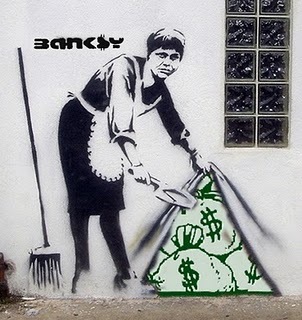 [we need money for the holy cleaners]
 [a monopoly board at the protest]
St. Paul's in London has had an anti-banker protest going on 24/7
for weeks now, and they tried, oh so ernestly, to kick those 'bums'
out, so that their banker friends, next door, in the London Stock
Excuse could roam freely over those lands that the people of
Jesus have consecrated.
St.Paul's has since relented, probably because they have smelt
the bacon frying, and that bacon was their butts. They would
have lost a large part of their remaining, dwindling flock, their
good name amongst the public and perhaps even their status as
State Religion Numero Uno.
Unfortunately for the Church hierarchy, St. Paul's costs money to run
and the bankers gave them 40 million of their ill-gotten filthy lucre,
and that's alright with many a bish.
Subscribe to:
Posts (Atom)


